

Meetings with plants: serviceberry tree
Bramble & Briar #166

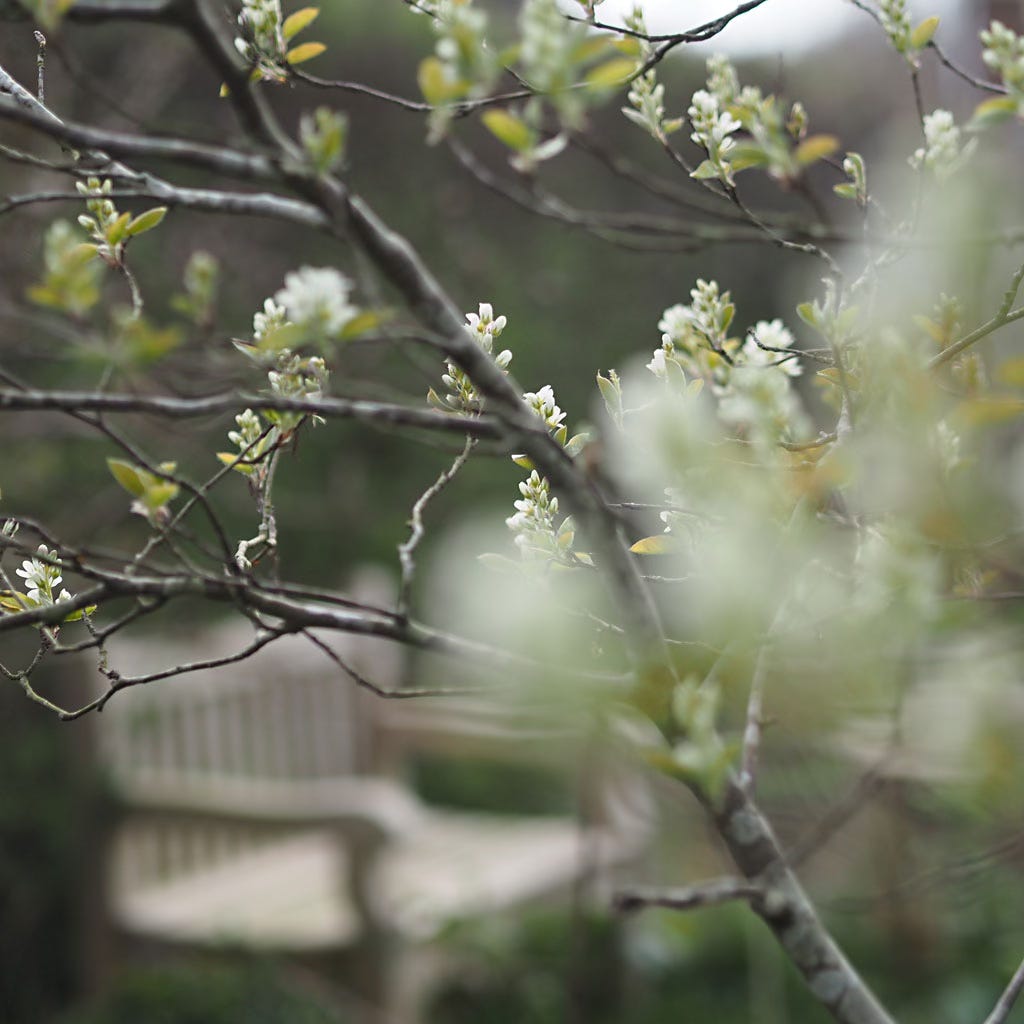
I had to force myself to type ‘serviceberry tree’ in the title of this post. It’s not how we think of this plant in the UK, where a humble, almost weedy shrub from North America gets treated with the reverence reserved for the exotic – at least for the time it takes for our attention to wane and move on to consume the next shiny thing. Here, no garden glow-up is complete without at least giving serious consideration to the inclusion of a multistemmed Amelanchier (canadensis or x larmarckii, people will tell you they know the secret of telling the two apart, but no-one really does, which isn’t so suprising given the likelhood of the former being one parent of the latter, the other being A. laevis). If you can uplight it at night, so much the better – by these signs you will know yourself to be a person of taste and good breeding. Or at least, to be someone with a garden designer inhabiting that description.1
Also, snowy mespilus, shadberry or juneberry. The snowy epithet is apt, and I can only assume that there aren’t that many amelanchiers around Minneapolis since, if there were, Mr Rogers Nelson would have known for sure that it ALWAYS snows in April. Of all the plants in my garden, including tulips, this is the one most closely associated with the fourth month of the year. April will barely have arrived before the blooming thing explodes in a froth of tiny, cream-white flowering candles, staunchly and marvellously resistant to the gusty spring winds until visited by bees and hover-flies, at which point, they abandon their petals to the breeze, and blanket the ground in falls of confetti.
The name ‘Juneberry’ should be self explanatory, though not for long. I don’t know of a berry more beloved by birds than the fruit of the amelanchier – every branch stripped of its cargo within days, often by the larger residents of the garden’s trees. Blackbirds, certainly; magpies, looking for a palate-cleanser between nestlings. It’s not uncommon to find a very fat wood pigeon wobbling around on a too-thin branch, wrenching berries off and gobbling them down in a kind of frenzy. If you can get to the fruit before the birds, it’s worth trying to take a harvest of something that feels not unlike like a blueberry in the mouth, but tastes more like a small cherry. As an after effect, there’s a hint of almondy cyanide, particularly if you chew on the pip. Not enough to worry about, though.
The amelanchier autumn show is a coppery orange affair, though mine has always had a tendency to fling its leaves off in a fit of pique before it quite gets to this point, most likely as a response to being sat in dry clay over the summer. Another cause can be a rusty fungus, but I’ve not seen this on ours, which seems otherwise perfectly well behaved in every respect, so we indulge its annual flounce.
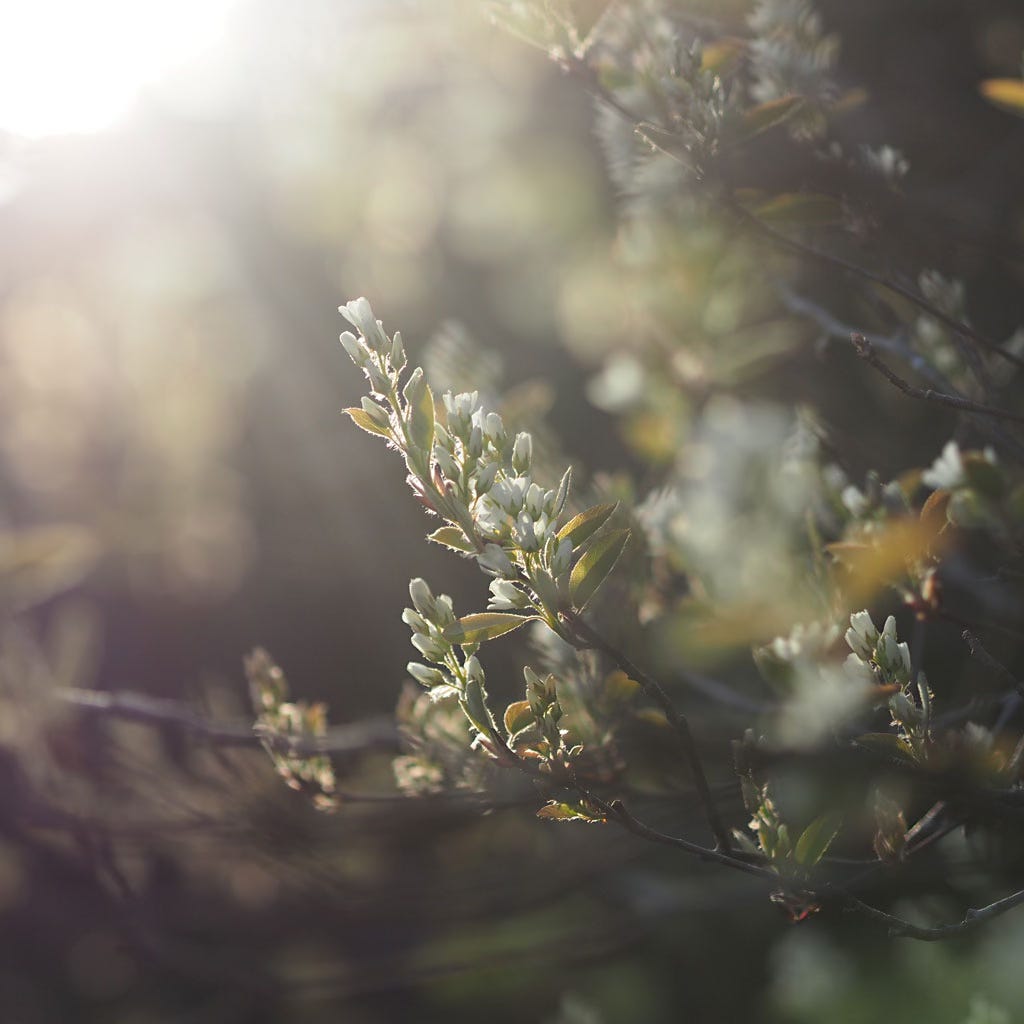
If you plant an amelanchier – often found on the list of “trees for small gardens” – just watch its inclination to shoot upwards. These plants sit squarely in that category described as “shrub/small tree” (if you even consider employing the portmanteau term “trub”, we’re done) and the general pruning advice is, where and when needed, to do so over winter. Which is daft, unless you want a load of vigorous, vertical stems. If you’re keen to have something that wanders more artfully skywards, consider doing any light pruning work after flowering, in late spring or early summer to minimise the risk of sap bleeding. Though, you’d be advised to wear a big hat – you may well be sharing the space with frenzied pigeons.
I often think of my friend Pollyanna Wilkinson in connection with this particular shrub, of which she’s a fan. In one of her earlier gardens, she memorably highlighted three single multi-stemmed specimens by placing each in front of a grey stone monolith, and underplanting them with Japanese forest grass Hakonechloah macra. Exquisite. (Uplighting may also have been involved)
I don’t mean to pick fault, but should we be lighting up trees at night? I’ve read from numerous people this disturbs birds an awful lot. Would you recommend putting lights on a timer? I wholeheartedly agree on the beauty of the tree though, my neighbour has a mature one which is stunning!
I have British garden designers to thank for introducing me to A. laevis, which happens to be native to where I live. Its common name here is ‘the Allegheny serviceberry’. It’s not commonly sold in nurseries or used in typical suburban landscape design. I planted two in our garden. They are both uplit.