

Meetings with plants: black elder
Bramble & Briar #175

When it comes to meetings with plants, my garden in May offers something of a frenzied networking opportunity. One of those events where new acquaintances come at you with such velocity, you know you’ve not a hope in hell of remembering anyone’s name, let alone attaching a salient detail to a face. A walk down the brick path just now is, if not noisy (discounting the constant birdsong – we’re blessed to share this space with vocal avian neighbours), at least busy – certainly at ground level. But while there’s always a fair chance of a tree reaching out to pluck the hat off your head as you pass by, things tend to get a little quieter as you move upwards; there’s still a bewildering amount of growth occurring, but the characters responsible are fewer and farther between.
One character who makes a significant contribution in this region is the black elder – one of those plants that manages to combine beauty and grace with a street fighter’s zest for life, the kind of fabulous, reliable stalwart whose company you seek out any day of the year, but especially on those occasions when you might be doubting your own horticultural prowess. “You planted me here,” it says, reassuringly, “and I’m looking pretty tremendous, wouldn’t you say?” Well, quite. You must be doing something right.
It has a very long botanical name which I shall now attempt to type from memory, hoping that the information is stored somewhere in the muscle memory of my fingers, because it’s certainly not in any part of my conscious brain.
{drumroll}
Sambucus nigra f. porphyrophylla ‘Eva’1
{applause}
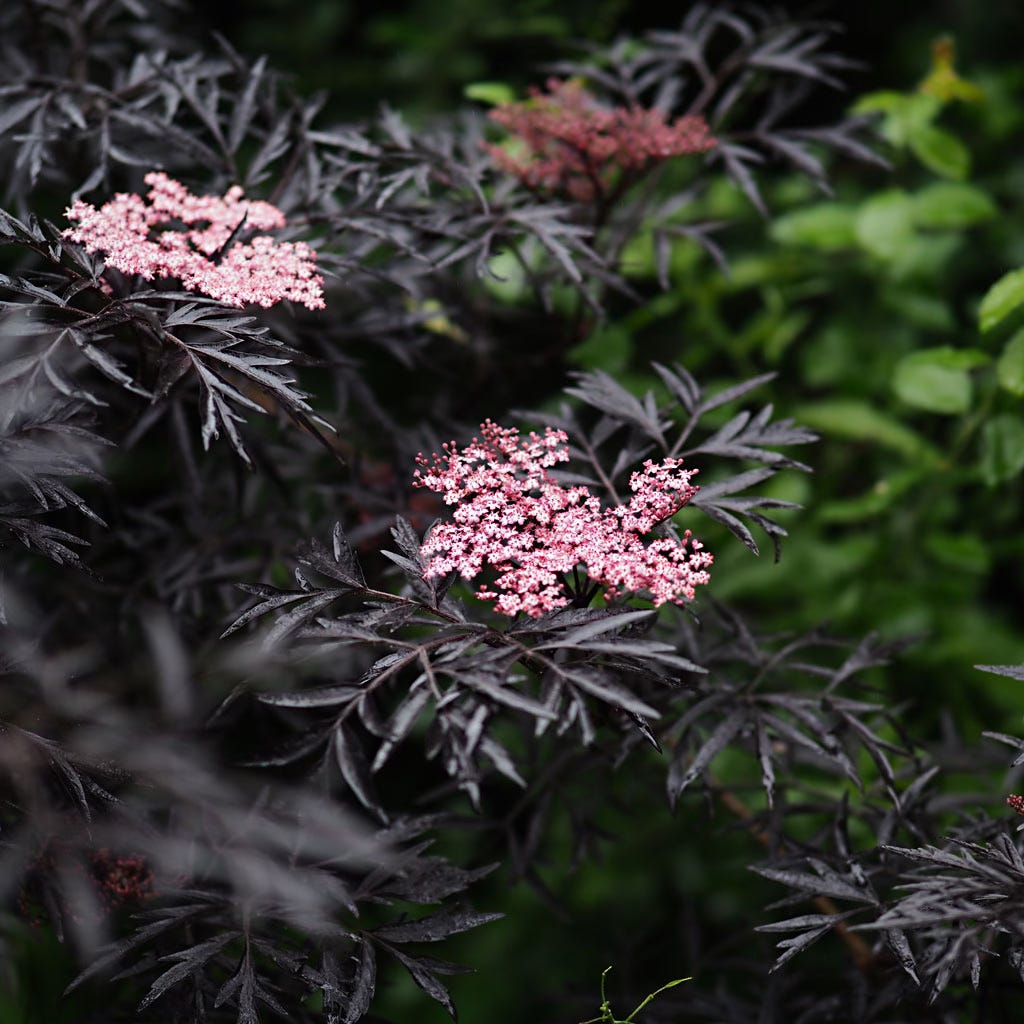
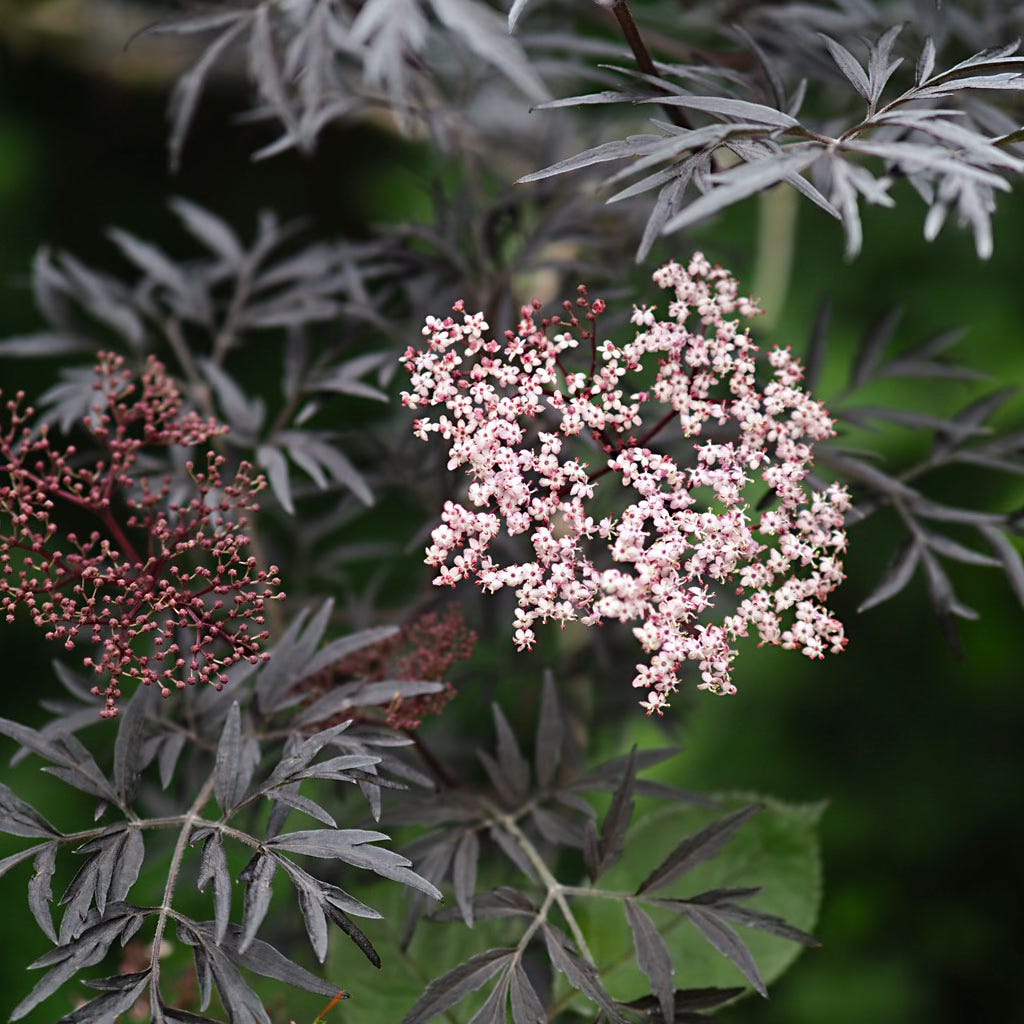
What can I tell you about this shrub? It’s an elder, just like the small trees we know from our hedgerows, only with a Wednesday Addams filter applied. The foliage, as expected, is pinnate, but a dark, plum purple-black, and so deeply divided that you might choose for your adjectival pick to scoot right on by ‘fern-like’ and opt for ‘feathery’ (I’ve heard ‘lacy’ used before, but that doesn’t quite capture it, even as a description of the similar variety ‘Black Lace’). The new stems also have that deep purple hue suggestive of some kind of enchantment, which might explain why soft tip cuttings are quite so ready to strike, though admittedly they share this power with the stems of their less glamorous relative. The same flowering habit too, the same great umbels of tiny blossom, only not cream in this case, but pink! Yes, you can make elderflower wine from them. Yes, it will come out blush pink.
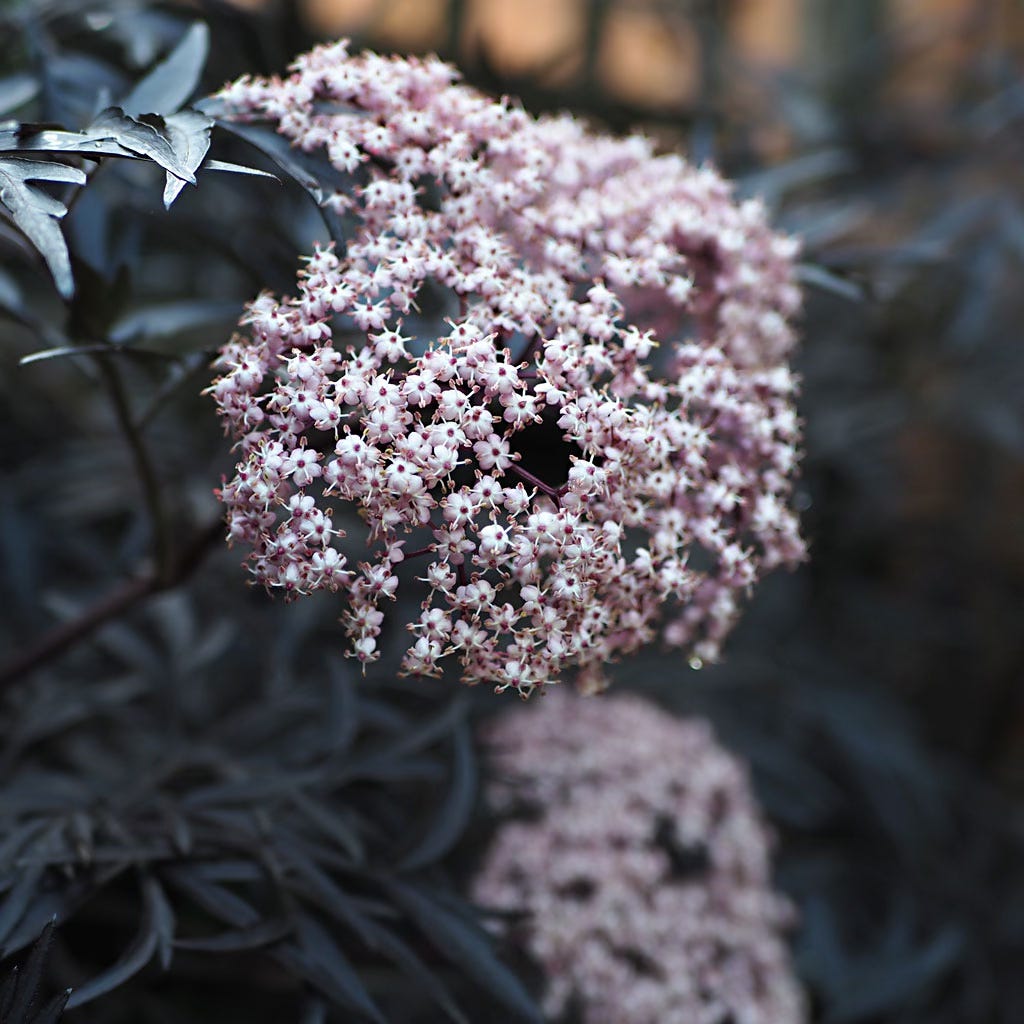
The flowers are a bonus for me. I wanted the great purple presence, the fourth beat of a rhythm set up right at the entrance to the garden by a plum coloured ninebark, picked up by Acer palmatum ‘Bloodgood’ and then Cotinus coggygria ‘Royal Purple’ over the way, before it gets thrown across the path for the elder to pick up. At which point it breaks up to be echoed in smaller waves through splashes on the leaves of persicarias, geraniums, and tinkles on the striped flowers of honey garlic.
It’s a big, gorgeous, deep purple muppet, and I can’t imagine gardening without it. If you’re not already growing it, might I suggest you rectify that, pronto?
in case you missed it…
would you believe the only bit I got wrong was calling it Eve instead of Eva?
It’s a lovely muppet indeed.